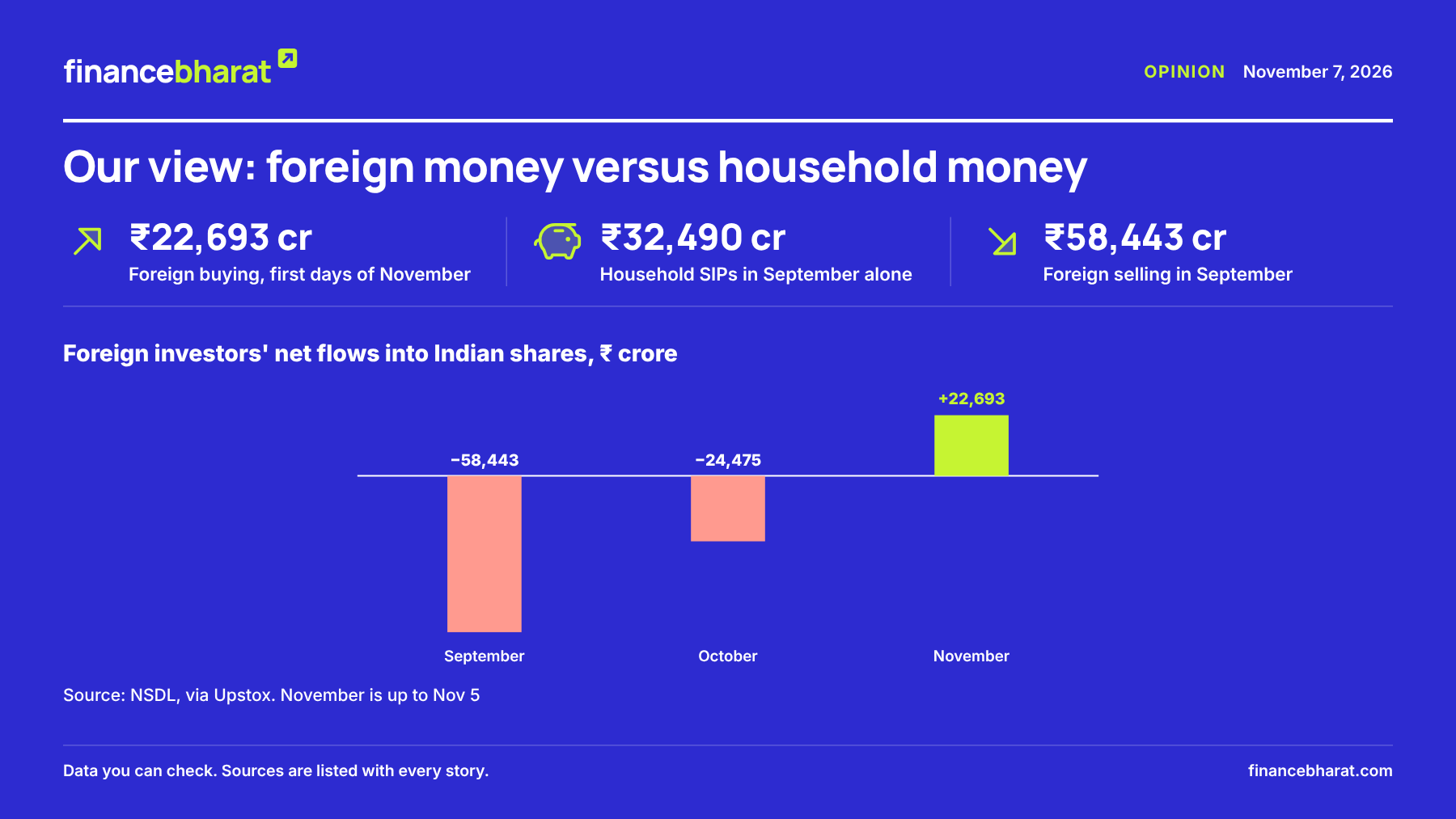
Foreign investors bought ₹22,693 crore of Indian shares in the first five days of November, after pulling out more than ₹80,000 crore in September and October. The Sensex had its best week in six years. It is tempting to read this as the world rediscovering India.
The timing says otherwise. The buying began as Wall Street turned on AI stocks after the US midterms. India looked attractive partly because it has few AI companies. That is a reason to park money here while the AI trade cools, not a judgment on Indian growth or earnings. If US tech recovers, or crude spikes, the same money can leave as quickly as it came.
The steadier money
The money that has really held up Indian markets this year comes from households. SIP inflows hit a record ₹32,490 crore in September, and they kept coming through months when foreign funds were selling heavily. That is the base the market should be valued on.
What policymakers should take from this
The answer is not to discourage foreign money. It is to keep making the domestic base deeper: more households investing regularly, more pension and insurance money in equities, and a bond market that can absorb outflows without sharp swings in the rupee.
Some would argue the inflows are justified by value, with the Nifty near a four‑year low on earnings. That is fair, and cheap valuations may keep some of this money here. But a week of flows is not a trend, and the rally was narrow, with midcaps flat and smallcaps lower on Friday.